So much talent in our church…we shook things up this morning..With Claire traveling and Andy and Marie also at a swim meet, Sean preached and led hymns and sang an interlude. Violet brought us in and out of worship with her rich toned violin. Janet taught the Sunday School. Below is Sean sermon and also the lyrics to his song, The Valley Wept.
Jesus Wept
The spiritual life consists a great deal of discerning between types of tears, not plugging them up. We can have worldly sorrow or godly sorrow — I suspect “no sorrow” is not in the cards.
Today’s Scripture Readings
Heb. 5:7-9
During the days of Jesus’ earthly life, He offered up prayers and petitions with loud cries and tears to the One who could save Him from death, and He was heard because of His reverence. Although He was a Son, He learned obedience from what He suffered. And having been made perfect, He became the source of eternal salvation to all who obey Him.
John 11:17-44
When Jesus arrived, He found that Lazarus had already spent four days in the tomb. Now Bethany was near Jerusalem, a little less than two miles away, and many of the Jews had come to Martha and Mary to console them in the loss of their brother. So when Martha heard that Jesus was coming, she went out to meet Him, but Mary stayed at home.
Martha said to Jesus, “Lord, if You had been here, my brother would not have died. But even now I know that God will give You whatever You ask of Him.”
“Your brother will rise again,” Jesus told her.
Martha replied, “I know that he will rise again in the resurrection at the last day.”
Jesus said to her, “I am the resurrection and the life. Whoever believes in Me will live, even though he dies. And everyone who lives and believes in Me will never die. Do you believe this?”
“Yes, Lord,” she answered, “I believe that You are the Christ, the Son of God, who was to come into the world.”
After Martha had said this, she went back and called her sister Mary aside to tell her, “The Teacher is here and is asking for you.” And when Mary heard this, she got up quickly and went to Him.
Now Jesus had not yet entered the village, but was still at the place where Martha had met Him. When the Jews who were in the house consoling Mary saw how quickly she got up and went out, they followed her, supposing she was going to the tomb to mourn there. When Mary came to Jesus and saw Him, she fell at His feet and said, “Lord, if You had been here, my brother would not have died.”
When Jesus saw her weeping, and the Jews who had come with her also weeping, He was deeply moved in spirit and troubled. “Where have you put him?” He asked.
“Come and see, Lord,” they answered.
Jesus wept.
Then the Jews said, “See how He loved him!”
But some of them asked, “Could not this man who opened the eyes of the blind also have kept Lazarus from dying?”
Jesus, once again deeply moved, came to the tomb. It was a cave with a stone laid across the entrance. “Take away the stone,” Jesus said.
“Lord, by now he stinks,” said Martha, the sister of the dead man. “It has already been four days.”
Jesus replied, “Did I not tell you that if you believed, you would see the glory of God?”
So they took away the stone. Then Jesus lifted His eyes upward and said, “Father, I thank You that You have heard Me. I knew that You always hear Me, but I say this for the benefit of the people standing here, so they may believe that You sent Me.”
After Jesus had said this, He called out in a loud voice, “Lazarus, come out!”
The man who had been dead came out with his hands and feet bound in strips of linen, and his face wrapped in a cloth.
Scripture Reflection
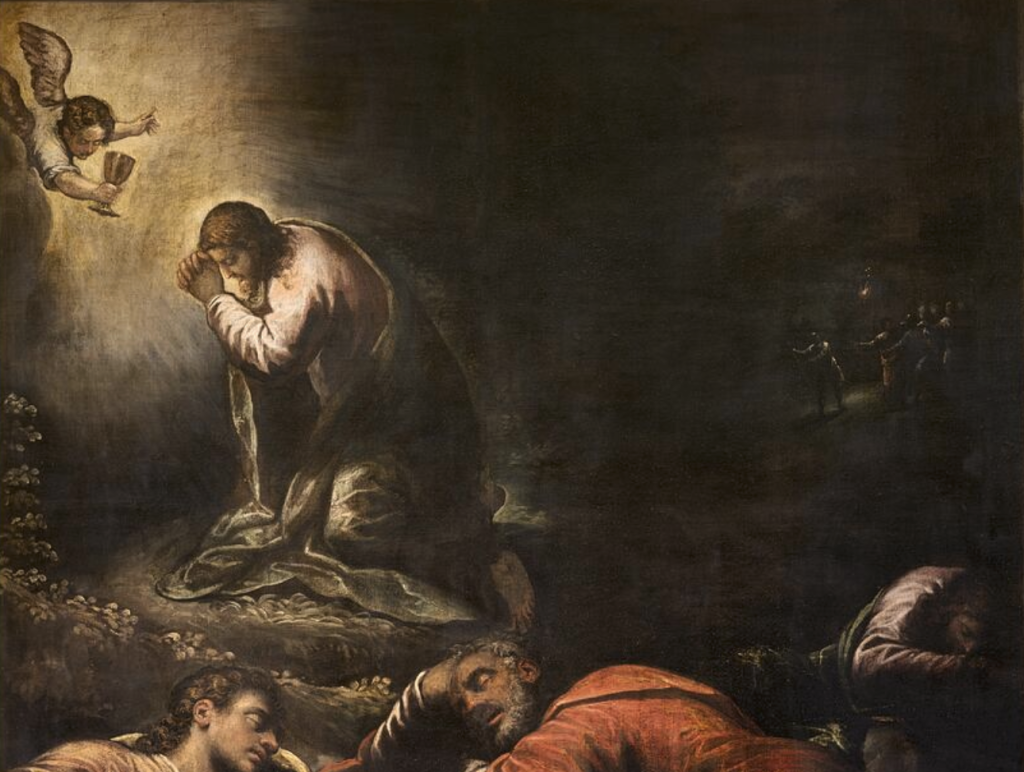
Jesus wept. He was no different from you and I in this way. The Bible says he wept often. He wept over Jerusalem’s lack of faith and hatred of God’s word, and her persecution of all those who lived by and spoke these words. He was troubled with sorrow at the Last Supper over Judas’ betrayal. He was sorrowful to the point of death in Gethsemane, when he prayed, “If it be your will, take this cup away from me. But not my will, but yours, be done.”
And He wept at the tomb of Lazarus.
There is a great misconception amongst spiritual seekers that the spiritual life must consist of a type of peace that is somehow unspotted by the turbulence of feelings. This is an inhuman standard. When we are told that the Lord promises “peace that surpasses all understanding,” we might assume that this peace will liberate us from what we assume to be negative feelings. But that is far too rational a conception of peace; it assumes far too much about what peace feels like. It makes it out to be more of a “peace that affirms our rational expectations” than a “peace that surpasses all understanding.”
Does anyone doubt that the Jesus who said, “My peace I give to you” was a man acquainted with sorrow and grief simply because he laid claim to God’s peace? But Isaiah’s vision of the divine peacemaker was precisely “a man of sorrows, acquainted with the deepest grief” (Is. 53:3). When Paul teaches about harmonious community living, he says not only to rejoice when others rejoice, but to weep when others weep (Rom. 12:15). This is how we live in peace — not by pushing one another to be “more spiritual”, or to “be more centered”, as if this would somehow cure the human condition of sorrows and grief — but by sharing in one another’s burdens, even the burden of feelings.
The burden of tears.
The tears of Jesus reveal a profound mystery: it is often with, and out of, great sorrow and grief that our prayers reach heaven. The closer Jesus got to Calvary, the more he wept. It is not simply for the horrors of the Cross that he wept, but for the intense longing of his prayers to God. He longed to see God’s will be done, that all people should be saved and come to knowledge of the truth (1 Tim. 2:4).
And he prayed just as he taught us, “Thy Kingdom come, thy will be done, on earth as it is in heaven.” The earth is worldly; were heaven’s will more like the world’s, surely Jesus’ exaltation in his Kingdom would have been to a glorious throne in Jerusalem, with a golden crown on his head and an iron rod in his hand. But heaven willed, instead, for his exaltation to the throne of the cross; a crown of thorns; and in his hands, cruel spikes.
And heaven also wills a cross for us — we know it because Jesus commanded it: “Carry your cross.”
There is a sorrow which hungers for ever more worldly life, and St. Paul teaches that this kind of sorrow leads to death. Because all of our days are numbered, it is vain to pray for our days to be filled with things we cannot take with us when we die. Why feel sorrow over these things? Easy come, easy go. And yet we do feel sorrow when they go — wordly sorrow.
But “godly sorrow produces repentance leading to salvation without regret” (2 Cor. 7:9-11). This is the type of sorrow with which Jesus sought his Father’s will, “[offering] up prayers and supplications with strong crying and tears unto him that was able to save him from death” — because it was God’s will that Jesus should drink from the cup of immortality, and be filled with the overflowing spirit of eternal life, rather than the empty riches of worldly vanity. That’s what it means to be “saved from death”. This is God’s will for us as well.
We too should offer up tearful prayers and supplications for this.
To the worldly — and that’s all of us — St. James preaches: “Be wretched and mourn and weep. Let your laughter be turned to mourning and your joy to gloom. Humble yourselves before the Lord.” These are words for all of us. Not one of us is innocent of opening up storehouses for the protection of worldly wealth. Most of us have bank accounts; at any rate, we all have pockets. This is the universal condition that James is speaking to here. “Be wretched and mourn and weep,” not because there is something profoundly sinful in this, but because it is a vanity; even at the most bare minimum, it is the exhausting labor of sowing into the flesh that which we will never reap when God calls us out of this flesh. “The flesh profits nothing,” Jesus taught.
Tomorrow is Monday, folks — this is exactly the grind we’re getting back into tomorrow! Sometimes, we go to bed on Sunday night dreading it. Sometimes, we can’t help but feel wretched, and mourn, and weep. It’s not because you lack spiritual peace — you’re feeling the same friction that even Jesus felt between the flesh and the spirit. This friction brings tears sometimes. It’s very real. We’re all called to our own cross, and Jesus wasn’t nailed to his to belittle our own. He carried his cross in solidarity with us, for our sake, and for God’s sake. He even once cried out, “Take this cup away from me,” as we sometimes do too. But with tears, he accepted it, and we should take heart that we can too — even with tears. Especially with tears!
That is peace that surpasses all understanding.
Jesus’ tears watered a great vine of eternal life. Had he not shed them, would he have gone to his cross and drained the cup, opening the way to the holy of holies, the presence of God Most High, for all people?
Had Jesus not wept, would Lazarus have been raised?
When we read this story, we marvel that Jesus raised the dead with his commanding words. But might we consider that the power of his prayer began with his weeping? We see many such times in scripture where a miracle is preceded by Jesus’ being moved by a supplicant, or by entire crowds; moved by pity for those hungering for loaves and fishes; moved by compassion for the sick, blind, deaf, and dumb in need of healing; moved by the faith of the Syro-Phoenecian woman who considered herself a lowly dog at the table of the Kingdom of God; it says he was so moved by the “harassed and helpless, like sheep without a shepherd,” that he became their shepherd.
He broke down and wept with all those mourning for Lazarus; and so he raised him from the dead.
Tears are powerful. I’ll never forget seeing a woman break down in tears years ago at a Brooklyn Yoga Cult I had the misfortune of briefly playing music for, as she narrated a tale about an unusual type of so-called “spiritual” marriage therapy gone awry; I’ll spare you the details, but she lost her husband’s heart to a whitewashed type of infidelity that had come highly recommended by those in her spiritual circle, and for which she had even paid, thinking it was a good idea at the time — until it wasn’t. She wept, and I watched her “spiritual” friends try to tell her she had to transcend these feelings toward “fifth dimension consciousness”, whatever that means, so that she’d feel no more “negative emotions”. That if she kept at her spiritual practice, she’d soon feel nothing anymore, and that was the goal. But it seems rather evident her tears were a “godly sorrow producing repentance.” Her so-called “spiritual” friends tried to quench the spirit of these tears — but her tears gave her the courage to leave this abusive cult.
On a lighter note, I had a very spiritual friend who, in his overeagerness to be “one with the ocean”, accidentally dove into a bunch of barnacles, and shredded himself up real good. “One with the ocean” indeed! — he got more than he bargained for. He was a full grown man, but he was howling with tears in pain. He kept trying to talk himself out of the pain and the tears, as if it was beneath the spiritual level he thought he’d attained. I’ll admit, we had a laugh over his spiritual hubris. But he was shaken up for a day or two, and his tears were precisely because he regretted his spiritual pride, which he used to lord over his friends until that day. I think these tears too were “godly sorrow producing repentance.”
And those were non-Christian examples. I’m sure there are Christian versions of the story. Maybe some men who grew up in Church heard, “boys don’t cry”; and maybe some women were told they were being too emotional, or have no reason to cry, or that it’s their own fault they’re crying (which is called gaslighting).
There can also be a type of “spiritual bodybuilding contest” that happens all across the board which makes it difficult for the members of Christ’s body to be vulnerable with one another.
But we don’t have to pretend to be strong, or immune to sorrow.
Someone might feel lost in life, and seeks support and spiritual camaraderie; someone might feel convicted about something they’ve done, and seeks to confess and confide, lightening their load.
We all stumble, but what happens when our brother or sister stumbles? Do we offer judgmental counsel — “if you were more spiritual you wouldn’t stumble” — or do we offer gracious counsel — “that’s the spiritual life, keep at it, we’re with you and so is Jesus”?
Empathy goes a long way. Rejoice when others rejoice, and weep when others weep, as St. Paul taught.
Weeping isn’t going anywhere. I think, in general, the spiritual life consists a great deal of discerning between types of tears, not plugging them up. We can have worldly sorrow or godly sorrow — I suspect “no sorrow” is not in the cards.
We have to be careful as Christians. The Bible does say that “weeping and gnashing of teeth” go together in what’s called “the outer darkness” — I suppose that could be one reason “spiritual people” might think that weeping is incompatible with the inner light, being the opposite of outer darkness, no?
But we’re not greater than the Son of God, who wept. In fact, I believe the record shows plainly that godly, sorrowful tears are part of the shining of this our “little light”. If the triumph of the Resurrection, and the abundance of eternal life, had its prelude in the tears of the Son of God, how much more so for us, his brothers and sisters in Our Father’s grace. Jesus often warned against hardness of heart, and we are not called to have hearts of stone. So let us “roll away the stone” as he commanded; and should our open hearts well up with tears, may our tearful sorrow be godly, and bear holy fruit.
Amen.
Song Meditation: “O Lord the Valley Weeps”
Lyrics: